Wednesday, April 23, 2014

Fundraiser Notecards

At the end of every Service Adventure term, the unit takes a year-end trip. This trip is a time to deepen our unit relationships, see a new part of the state that we maybe weren’t able to earlier, and have a fun time before ending our term and heading back home. This year, we are planning to explore the Kenai Peninsula, an area of land south of Anchorage and how to all sorts of interesting and beautiful places and events. To help raise funds for this trip, our unit is selling (limited edition) nature photography notecards. Each notecard set features 10 different images of local Alaskan beauty, made by myself or one of my unit mates, Marlene Allebach. Images are printed on high quality glossy cardstock and come with accompanying envelopes. The price is $20 per notecard set. If you live outside Anchorage, we are offering free shipping! You can order and pay with PayPal by following this link or email me at mrkreider@cox.net and send us a check in the mail (made out to Service Adventure) to 1310 W. 47th Ave, Anchorage, AK, 99503. I would also be happy to answer any questions you may have. Our unit thanks you for your support – through financial means, prayer, and all the other ways you help to make our experience possible. Thank you!

The front of the notecard set box

The back of the box, showing the 10 images featured.

Three of the Alaskan nature photography images featured.


Sunday, April 20, 2014

Easter!


Happy Easter everyone! This morning the new dawn ushered in new life and light. Through Jesus’ resurrection, God has triumphed over death. Love has made a mockery of evil and we are given a new hope. I hope you have a joyful Easter season and enjoy these few photos of our window garden – a sign of the new life we see in Christ.

green onions
spinach

tomatoes
And finally, some of the eggs our unit dyed on Saturday - one of my favorite Easter activities!

Tuesday, April 15, 2014

A Glacial Glimpse


For many of you reading this, I would presume that winter is either partially or fully done with the process of ceding power over to spring. The same is happening here in Anchorage; sidewalks are mostly clear of snow, it is beginning to smell earthy and fresh, and one hears birds chirping in delight. However, before winter is reduced to only a memory, I would like to share one last adventure from the season. 

Several weeks ago, our unit drove down to Portage Glacier, one of the closest accessible glaciers to Anchorage. About 45 miles southeast of Anchorage, we have been meaning to check out the glacier for a while now, and finally took the opportunity. Like so many glaciers in the world today, Portage Glacier has retreated significantly over the past several decades (check out http://extremeicesurvey.org/, a project combining the art and science of photography to document the effects of climate change and other human activities on glaciers).  In 1986, a visitor center was built at one end of Portage Lake, across which the glacier lay. Today, the glacier has retreated around the flank of a mountain and can no longer be seen from the visitor center. In order to see it, folks are left with the options of hiking in, taking a short cruise, or through the use of a plane. In winter however, Portage Lake is frozen and so we were able to ski across the lake to see the face of the glacier. 
A graphic showing the retreat of Portage Glacier, around the corner and out of sight of the Visitor Center
Skiing across the lake to the glacier (which can't be seen in this image but is about a mile straight in, and then right)

A glacier is a thing of great beauty, and a clear blue sky served to heighten its appearance, allowing light to penetrate down into the blue recesses of the ice. Glaciers are otherworldly in their form and gigantic scale. Portage is a small glacier compared with many others in Alaska and elsewhere, but humans are still dwarfed by the huge face. I was drawn to the jagged forms of some of ice and the smooth, sculpted form of other parts. 


A glacier is also a thing of great power. Though one may initially think of glaciers as inert objects, they are in constant motion. As we watched the glacier, loud pops, cracks, and grating sounds could be heard from within. We witnessed several small ice calving events, the process whereby pieces of ice break away from the face of the glacier. The largest of these, upon falling from the face, produced a surface wave on the ice; much like what happens when something is dropped into water. It was slightly unsettling to see the ice sheet a quarter mile away rising and rippling towards us. Glancing sideways towards where the ice-covered lake met a rock cliff, one could see the entire ice sheet we were standing on moving slowly up and down perhaps a foot or more.  In fact, ice is very flexible and a small disturbance like this probably isn’t anything to worry about, provided you are a safe distance away from the calving face. But it does pay to take heed of the potential dangers associated with glaciers and respect the tremendous power that exists within them.
A chunk of ice calves off from the face of the glacier 
people probably standing too close to the glacier

two figures are dwarfed by the glacier


Friday, April 4, 2014

Naan, Basil, and more


For as long as I can remember, I have enjoyed food. I am glad to have been born into the family I was – for, among other things, the great culinary habits it brought with it. Healthy, hearty, delicious food, tasty ethnic dishes like curries, hummus, or African dishes, a strong gardening and growing ethic, and the list goes on. However, I have always been little more than a consumer of this delicious food. In Service Adventure, I am changing that and finding myself increasingly drawn to actually cooking food (though this has not lessened my enjoyment of the food with others!). I previously wrote a blog on cooking in the unit (here), and I thought I would share a slice of what has been going down recently in the Service Adventure kitchen.

My first order of business was at the grocery store. With a maximum budget of $65, it is always a lesson in compromise. My unit mates often call me out on the high percentage of the food budget that goes towards vegetables while I am cooking, but I stand steadfast in my decision. Should it come down to a decision between meat and vegetables, I’ll usually err on the side of the latter. Plus, we have a freezer downstairs full of salmon so we might as get items that aren’t readily available (or shouldn’t be at all in Alaska if you take a hardcore local stance!) like these vegetables. Of course, we already had some items like eggs, potatoes, flour, butter, etc. on hand which freed up space. In addition, much to the chagrin of my Pennsylvanian, dairy-farming fellow Service Adventurer, I decided to not buy any milk for my week as head chef in order to make room for other ingredients. It might be a few more weeks before we are friends again. Below is the grocery purchase for one week.

The grocery purchase, roughly left to right; celery, leeks, cauliflower, frozen mixed vegetables, pears, carrots, onions, sweet potatos, olive oil, yogurt, pine nuts, feta cheese, garlic, tomatoes, coconut, green curry sauce (they didn’t have the paste), and pepper jack cheese.

One question I wondered to myself was where on the spectrum of frugality and simplicity to extravagant and gourmet is the most responsible point to land. One of the things we are learning while in Service Adventure is how to live simply. How should that translate into the food we buy? It is an unavoidable fact that eating healthily and organically generally costs more. Of course, sometimes some items like rice and beans can be both less expensive and healthier than processed and packaged foods, but by and large, you get what you pay for. I would be interested in what you think, my dear reader. How does one avoid becoming some sort of privileged, affluent, elitist eater while at the same time cooking healthy, colorful, delicious, and interesting food?

Well here are a few of the meals or culinary projects I embarked upon. These are drawn from my two weeks of cooking recently (one of which was made with the grocery image above)
Chicken curry on basmati rice, naan, dahl, and tomato chutney

fresh baked naan - so delicious and really easy to make!


Tomato bisque with apple/strawberry/cranberry crisp
One day, my unit mate who works at a local soup kitchen brought home large amounts of both basil and rosemary. I’ve always been a huge fan of basil, so it was quite the exciting thing to see. It was in need of quick use, so after purchasing several specific ingredients, we whipped it up into pesto and froze it into ice cubes for later use.
basil and rosemary

making the pesto
the pesto ready to be frozen in cubes

One evening was pizza night!
my "sous-chef" assembling a pizza

a baked pizza, with all sorts of toppings - white sauce/pesto for the base, tomatoes, spinach, basil, onions, feta, pepper jack, kalamata olives, green onions, etc...
A week after the basil incident, my unit mate brought home more basil, this time enough to stock a large grocery store for several weeks. We then had basil incident number two, only on a much larger scale than the first.
basil, basil, and more basil...
We set out preparing to store it in several ways: pureeing it with olive oil, pureeing it with just water or canola oil, blanching the leaves and storing as is, or just pureeing the blanched leaves. The basil slurry was then frozen in ice cube tray. It will be interesting to see how well each method ends up working – and no matter what, we’ll have no dearth of basil for the rest of the unit.

At the end of my cooking stint, I was slightly ready to not cook for a while, but I was left with new ideas for meals and many things to improve upon.

Coconut milk and garlic that I received from my work leader at the BLM. The only stipulation? To bring what ever I made with in it to work. Any ideas?


Saturday, March 29, 2014

Into the Alaska Range


One of the things that makes Alaska unique is the vast amount of the state without any road system. Whereas Kansas has over 140,000 miles of public roads, Alaska has less than 16,000 miles. The difference is even more drastic considered that Alaska is over eight time as large as Kansas. The point is, there is a lot more to Alaska than one can see from the seat of a car. I recently got a chance to see one part of that Alaska – wild, sweeping, and remote.


The story begins a month ago as I was getting ready to fly to Unalakleet, a small city on the western coast of Alaska. I was to be out on the Iditarod Trail with another BLM employee during the Iditarod – checking in on BLM public use cabins along the trail and performing other duties related to the race. It was a disappointment, then, when the trip was cancelled due to unnaturally warm temperatures and lack of snow. Our snowmachines would be of less use than four-wheelers, as much of the snow was completely gone along the trail. Last week however, I was given another chance to experience a part of Alaska beyond the Anchorage area. The same BLM employee I was to go out with on the Iditarod trail needed to do a “post-event inspection” of one of the Iditarod checkpoints, to make sure everything at the cabin and surrounding site was in order after all the mushers went through. The checkpoint happened to be Rohn Cabin, located in the Alaska Range and home to some of the best scenery along the Iditarod route. As it turned out, there was an extra seat on the airplane heading out to the cabin and so I was able to catch a ride, and also serve as the “official photographer” (a more ceremonial title than anything, though I did document the inspection of the site). Just under 140 miles northwest of Anchorage, the flight in the single-propeller airplane took an hour and fifteen minutes. 
 
the plane we flew in with

Of course, it felt much shorter as the snow-capped mountains and clear blue sky captivated me and the other three souls on board.


Interesting to see some of the cuts that have been made through the land.


Mount Foraker, left, and Mount Denali, right as seen from about 70 miles away.

Mounts Foraker and Denali respectively again on the horizon


We were on the ground for only an hour and a half – and that included lunch. We inspected the cabin, to make sure everything was clean and in order. Another thing we checked was the pile of straw that had been used for dog bedding – it all needs to be burned or airlifted out.
Rohn Cabin, a BLM public shelter cabin and checkpoint on the Iditarod trail

My fellow BLMer checking the straw that will need to be taken care of to avoid spreading invasive species.

on the ground at Rohn 


After our short time on the ground, we all loaded back up in the plane and headed back to Anchorage. It was a little surreal, being whisked out into the middle of a huge wilderness, and then back to civilization in a matter of hours. In any case, it was quite an experience – and a great way to see a part of Alaska I never would have been able to see otherwise.


Thanks for reading my blog and keep on enjoying your extra minutes of daylight!


Friday, March 21, 2014

Fairbanks and the Arctic Winter Games


Though we weren’t able to attend the winter Olympics in Sochi, this past weekend, our unit got a little flavor of what the games might have been like. We had the privilege of volunteering with the 2014 Arctic Winter Games held in Fairbanks, Alaska. The Arctic Winter Games, held every two years, is a “high-profile circumpolar sport competition for Northern and Arctic athletes” – mainly youth, ages 12-18.  There were 9 “contingents” of athletes: teams Alaska, Greenland, Sapmi (a group of indigenous peoples of northern Scandinavia), Yamal (one of the provinces of Russia), and several teams from various regions of Canada. Approximately 2,000 athletes from these respective teams competed in any one of 20 events, ranging from traditional native games to winter snow sports to games like basketball, indoor soccer, and ping-pong.


As volunteers, our group did just that – volunteer. The first evening volunteering, we set up beds and accommodations for teams as they arrived. It was a fun to be amongst the athletes: a group from Russia participating in wrestling, an entourage of Norwegian cross-country skiers, a number of Greenlandic youth taking part in traditional native sports, and more. At times there were language barriers, but smiles basically transcend all obstacles and I could identify with these teenagers as they engaged in horseplay and chased each other through the halls. (Another humorous thing was seeing many athletes from outside the US or Canada flocking to the vending machines and McDonalds of Fairbanks - quintessential “American” institutions, for good or for worse…)

Most of my volunteering, however, consisted of event photography. Several months ago when applying to be a volunteer, the position of photographer caught my eye. Over the course of the three days, I photographed volleyball, indoor soccer, and slalom snowboarding. My photography background consists almost entirely of nature photography, but I enjoyed this jaunt into new subject matter. Also, it gave me an excuse to be up and close to the games!


I came away from my time at the Arctic Winter Games with a heightened appreciation of the diversity of the world. This event is such a cool fusion of cultures, people, languages, and traditions. An interesting moment occurred at the Opening Ceremonies when a local high school vocal group sang all the national anthems of those represented at these games. I don’t tend to be an overly patriotic individual, but hearing all the national anthems made me proud to live in a world with so many diverse, unique, and rich groups of people.

Of course, we also had time to explore Fairbanks outside of the Arctic Winter Games. Our first night up, we headed out of town to Chena Hot Springs and enjoyed some time in the springs, around which a resort has sprouted up. The springs are an average of 106 degrees year round, and we heard stories from previous units of how exciting it was to have your hair freezing while your body was surrounded by warm water. However, for the first half of our long weekend, it was rather balmy: 45 degrees when we arrived in Fairbanks. Though we were mostly appreciative of the lack of -40 degree temperatures (something that Fairbanks is known for), no hair froze during our stay in the springs. That night, we stayed at a public use cabin, enjoying the wood stove, our warm sleeping bags, and a short ski jaunt in the morning.
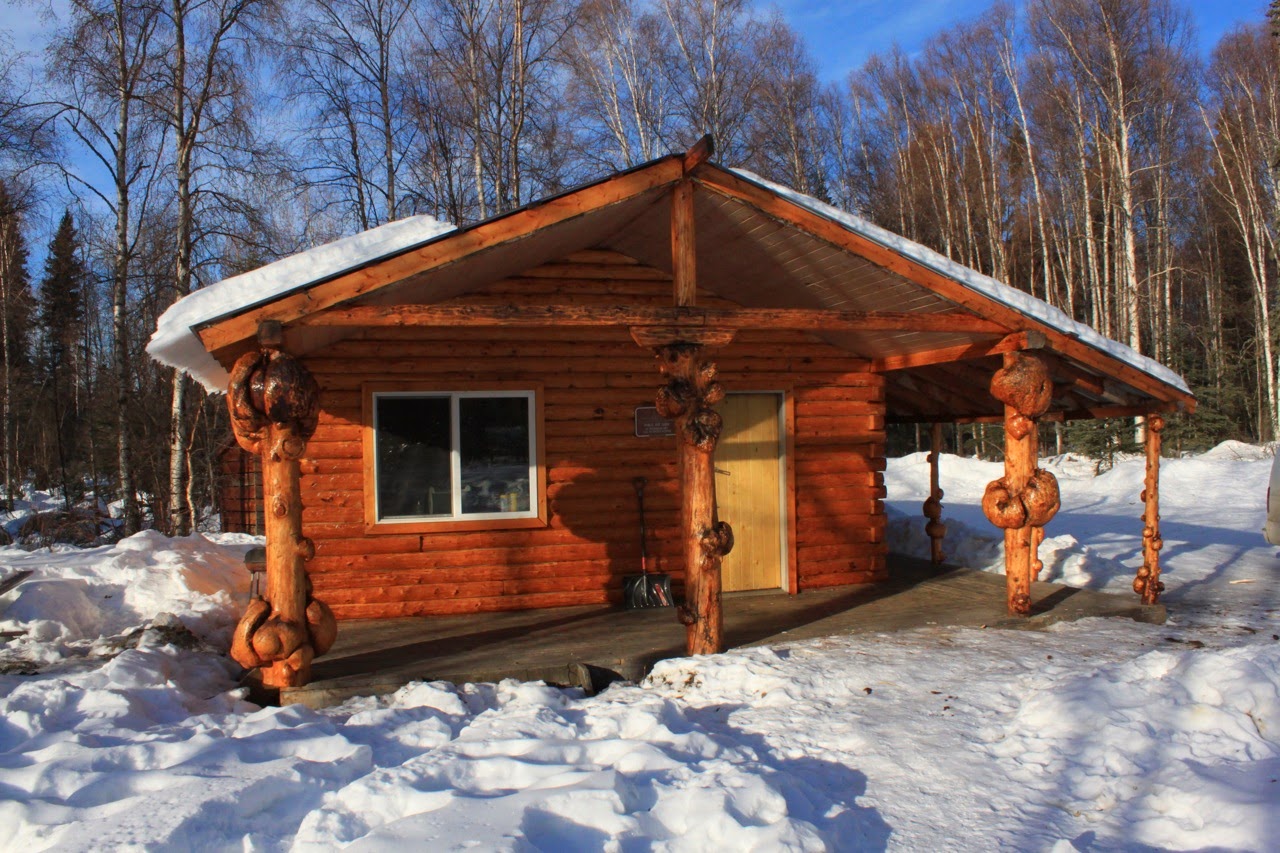
The public use cabin

cooking up breakfast

During our time volunteering, we were fortunate to stay in the house of a member of fledgling Fairbanks Mennonite fellowship. Like a good number of homes in Fairbanks, this house did not have running water. As such, we filled up a 5 gallon jug every day in town to replenish what we had used the day before. Nevertheless, it was a great place to stay and we were all very comfortable.
The house at night with the moon

The outhouse with red heat lamp!

Fairbanks is known for hosting the World Ice Art Championships. We got in on the festivities one afternoon and meandered through the multitude of ice sculptures. Ranging from single block carvings to huge, towering creations, we were in amazement at the skill of these ice carvers. Artists come from all over the world to compete in this event, each producing a magnificent ice creation in the end. 


Leah getting eaten by an ice bear.
And so, we returned home after our long weekend, a little tired, but with plenty of memories of Fairbanks and the Arctic Winter Games.
Though Fairbanks is known for its good northern lights, this is the best we saw during our stay. Still fun, though!