Saturday, March 29, 2014

Into the Alaska Range


One of the things that makes Alaska unique is the vast amount of the state without any road system. Whereas Kansas has over 140,000 miles of public roads, Alaska has less than 16,000 miles. The difference is even more drastic considered that Alaska is over eight time as large as Kansas. The point is, there is a lot more to Alaska than one can see from the seat of a car. I recently got a chance to see one part of that Alaska – wild, sweeping, and remote.


The story begins a month ago as I was getting ready to fly to Unalakleet, a small city on the western coast of Alaska. I was to be out on the Iditarod Trail with another BLM employee during the Iditarod – checking in on BLM public use cabins along the trail and performing other duties related to the race. It was a disappointment, then, when the trip was cancelled due to unnaturally warm temperatures and lack of snow. Our snowmachines would be of less use than four-wheelers, as much of the snow was completely gone along the trail. Last week however, I was given another chance to experience a part of Alaska beyond the Anchorage area. The same BLM employee I was to go out with on the Iditarod trail needed to do a “post-event inspection” of one of the Iditarod checkpoints, to make sure everything at the cabin and surrounding site was in order after all the mushers went through. The checkpoint happened to be Rohn Cabin, located in the Alaska Range and home to some of the best scenery along the Iditarod route. As it turned out, there was an extra seat on the airplane heading out to the cabin and so I was able to catch a ride, and also serve as the “official photographer” (a more ceremonial title than anything, though I did document the inspection of the site). Just under 140 miles northwest of Anchorage, the flight in the single-propeller airplane took an hour and fifteen minutes. 
 
the plane we flew in with

Of course, it felt much shorter as the snow-capped mountains and clear blue sky captivated me and the other three souls on board.


Interesting to see some of the cuts that have been made through the land.


Mount Foraker, left, and Mount Denali, right as seen from about 70 miles away.

Mounts Foraker and Denali respectively again on the horizon


We were on the ground for only an hour and a half – and that included lunch. We inspected the cabin, to make sure everything was clean and in order. Another thing we checked was the pile of straw that had been used for dog bedding – it all needs to be burned or airlifted out.
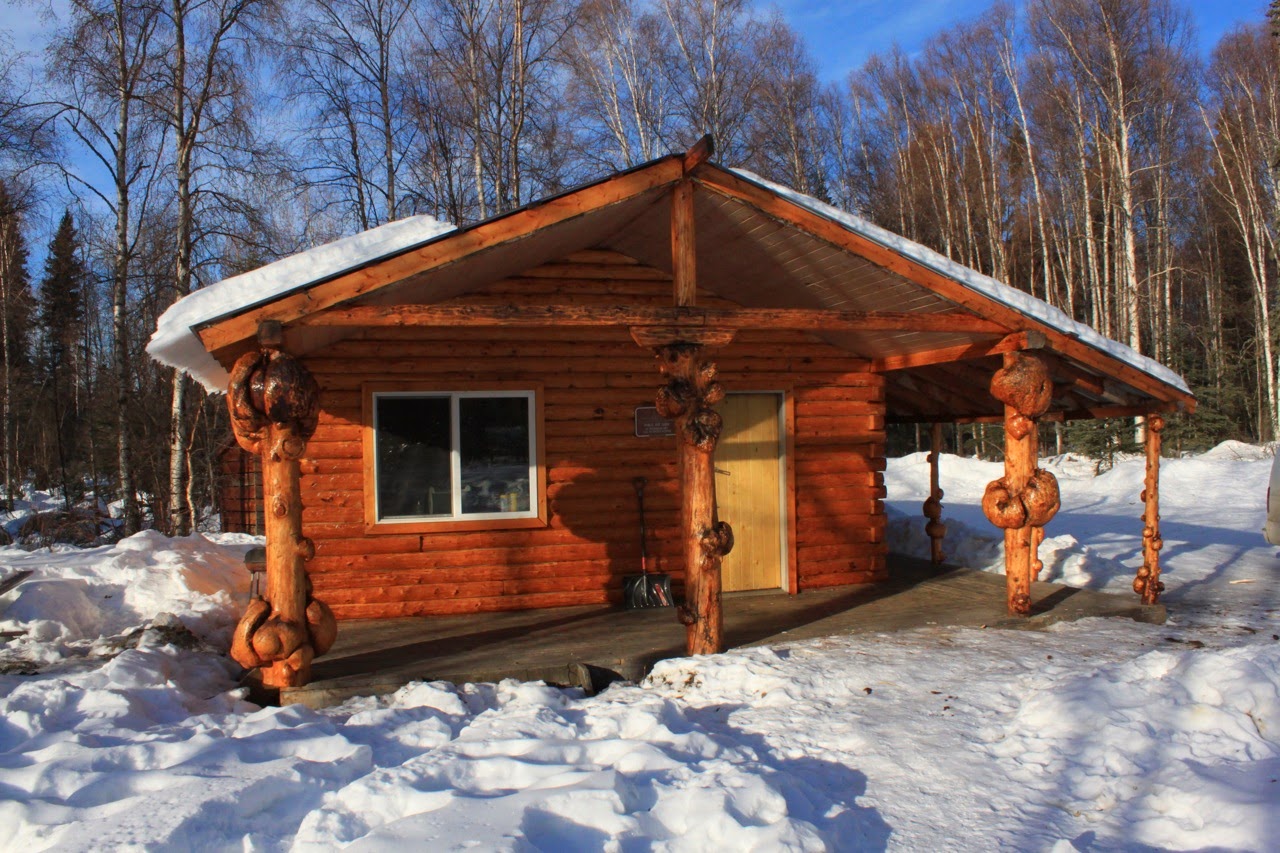
Rohn Cabin, a BLM public shelter cabin and checkpoint on the Iditarod trail

My fellow BLMer checking the straw that will need to be taken care of to avoid spreading invasive species.

on the ground at Rohn 


After our short time on the ground, we all loaded back up in the plane and headed back to Anchorage. It was a little surreal, being whisked out into the middle of a huge wilderness, and then back to civilization in a matter of hours. In any case, it was quite an experience – and a great way to see a part of Alaska I never would have been able to see otherwise.


Thanks for reading my blog and keep on enjoying your extra minutes of daylight!


Friday, March 21, 2014

Fairbanks and the Arctic Winter Games


Though we weren’t able to attend the winter Olympics in Sochi, this past weekend, our unit got a little flavor of what the games might have been like. We had the privilege of volunteering with the 2014 Arctic Winter Games held in Fairbanks, Alaska. The Arctic Winter Games, held every two years, is a “high-profile circumpolar sport competition for Northern and Arctic athletes” – mainly youth, ages 12-18.  There were 9 “contingents” of athletes: teams Alaska, Greenland, Sapmi (a group of indigenous peoples of northern Scandinavia), Yamal (one of the provinces of Russia), and several teams from various regions of Canada. Approximately 2,000 athletes from these respective teams competed in any one of 20 events, ranging from traditional native games to winter snow sports to games like basketball, indoor soccer, and ping-pong.


As volunteers, our group did just that – volunteer. The first evening volunteering, we set up beds and accommodations for teams as they arrived. It was a fun to be amongst the athletes: a group from Russia participating in wrestling, an entourage of Norwegian cross-country skiers, a number of Greenlandic youth taking part in traditional native sports, and more. At times there were language barriers, but smiles basically transcend all obstacles and I could identify with these teenagers as they engaged in horseplay and chased each other through the halls. (Another humorous thing was seeing many athletes from outside the US or Canada flocking to the vending machines and McDonalds of Fairbanks - quintessential “American” institutions, for good or for worse…)

Most of my volunteering, however, consisted of event photography. Several months ago when applying to be a volunteer, the position of photographer caught my eye. Over the course of the three days, I photographed volleyball, indoor soccer, and slalom snowboarding. My photography background consists almost entirely of nature photography, but I enjoyed this jaunt into new subject matter. Also, it gave me an excuse to be up and close to the games!


I came away from my time at the Arctic Winter Games with a heightened appreciation of the diversity of the world. This event is such a cool fusion of cultures, people, languages, and traditions. An interesting moment occurred at the Opening Ceremonies when a local high school vocal group sang all the national anthems of those represented at these games. I don’t tend to be an overly patriotic individual, but hearing all the national anthems made me proud to live in a world with so many diverse, unique, and rich groups of people.

Of course, we also had time to explore Fairbanks outside of the Arctic Winter Games. Our first night up, we headed out of town to Chena Hot Springs and enjoyed some time in the springs, around which a resort has sprouted up. The springs are an average of 106 degrees year round, and we heard stories from previous units of how exciting it was to have your hair freezing while your body was surrounded by warm water. However, for the first half of our long weekend, it was rather balmy: 45 degrees when we arrived in Fairbanks. Though we were mostly appreciative of the lack of -40 degree temperatures (something that Fairbanks is known for), no hair froze during our stay in the springs. That night, we stayed at a public use cabin, enjoying the wood stove, our warm sleeping bags, and a short ski jaunt in the morning.
The public use cabin

cooking up breakfast

During our time volunteering, we were fortunate to stay in the house of a member of fledgling Fairbanks Mennonite fellowship. Like a good number of homes in Fairbanks, this house did not have running water. As such, we filled up a 5 gallon jug every day in town to replenish what we had used the day before. Nevertheless, it was a great place to stay and we were all very comfortable.
The house at night with the moon

The outhouse with red heat lamp!

Fairbanks is known for hosting the World Ice Art Championships. We got in on the festivities one afternoon and meandered through the multitude of ice sculptures. Ranging from single block carvings to huge, towering creations, we were in amazement at the skill of these ice carvers. Artists come from all over the world to compete in this event, each producing a magnificent ice creation in the end. 


Leah getting eaten by an ice bear.
And so, we returned home after our long weekend, a little tired, but with plenty of memories of Fairbanks and the Arctic Winter Games.
Though Fairbanks is known for its good northern lights, this is the best we saw during our stay. Still fun, though!

Monday, March 10, 2014

The Iditarod


Last weekend Anchorage was a flurry of celebration, excitement, and people (notably people from outside Alaska). The source of all these festivities, of course, was the start of the Iditarod. The famed sled dog race runs for almost 1000 miles across Alaska and up its western coast. Billed as “the last great race” the Iditarod draws the attention of the nation (and the world) as the mushers and their dogs make the epic journey from Anchorage to Nome. Actually, Anchorage is home to the “ceremonial” start – the real racing begins the next day in a town 80 miles north. That doesn’t stop the Anchorage ceremonial start from being a huge media and fan favorite. The mushers begin in downtown Anchorage, where snow has been left on the streets for the sleds, and travel across town to Campbell Tract, where the Bureau of Land Management (and my workplace) is located. Campbell Tract is home to a gravel airstrip that provides a good place to end the ceremonial start. As a maintenance worker at BLM, I was fortunate to help out – both with preparation and for the actual event.

A ceremonial musher who was the first to arrive - they were decked out as if they were from the olden days, using the dogs to carry a large load a long distance

During the winter, we packed the snow on the end of the airstrip where musher’s trucks congregate as teams load up their sleds and dogs after coming from downtown. Several days before the event, we cleared off the loose snow from the top, set up fencing to keep the public separated from the mushers, and made sure all parking areas and walkways were salted, spread with gravel, and safe as could be.

The ceremonial start draws a huge crowd, with most in downtown Anchrorage. However, we had upwards of 2000 people at the Bureau of Land Management to take in the action. The field of 69 mushers arrived, each spaced out a couple minutes from the next.


This year, the race drew competitors from all over the world – Norway, Australia, Jamaica, New Zealand. It’s fun to see the whole spectrum of mushers: some competing to to win, others just out for the experience, and others somewhere in between. Since the ceremonial start is after all ceremonial, the mood is light and festive.
Newton Marshall, a musher from Jamaica and crowd favorite!

After arriving, each musher directed his or her dogs to the teams’ truck where the dogs were fed, watered, and then loaded up to head off for the next day’s official start. Sled dogs are used to cold weather, and the high 30 degree temperatures we had were a far cry from their optimal operating temperature of around 0 degrees. As a result, many dogs were rubbing the heads and necks in the snow – trying to cool off after their brief trot.
Having a little meal before being loaded up in their kennels.
The dog water tank that it was my responsibility to clean out, fill up, and transport out to the airstrip


It was exciting to cross paths with the Iditarod race. It is the one time that the wider public has a chance to be up close to race, as most people can only follow the actual competition from afar. It really is one of the last “great races” – it is grueling, extreme, and of epic proportions.  But it also can bring out the best in people – mushers helping each other out on the trail or a small village coming together to support the racers at a checkpoint. In any case it has been a wonderful privilege to be in Alaska for the 2014 Iditarod Sled Dog race.

Monday, February 10, 2014

A Fine Weekend


Hard to beat the view while cross-country skiing at Hatcher Pass!
While the workweek has its merits, it is the two days beginning with “S” that hold the most excitement for me. I’ve found that the weekend’s allure has not diminished whatsoever during my temporary absence from the world of academia. And of the 25 weekends I’ve been privileged to experience in Alaska, this past on ranks pretty high.


at Hatcher Pass
A week or so ago, our unit was talking and we realized we hadn’t really gone anywhere or done anything outside our ordinary routines for some time. We resolved to do some sort of day trip or excursion and experience a new part of Alaska.

Thus, on Saturday morning, we all loaded into the unit van and headed off to Hatcher Pass. Just under an hour and a half north of Anchorage, this pass through the Talkeetna Mountains is a favorite spot for outdoor recreation, especially in the winter. Of special interest to us was the area around at Independence Mine. This former gold mine is located in a valley that also boasts great cross-country skiing as well as opportunities for downhill fanatics to get their fix.

Note the trail across the side of the ridge (and there's one that's hard to see on the very top face of the mountain!). We didn't take such chances with avalanches, though it would have upped the adrenaline a little.

Figures are dwarfed by the landscape.
The day we chose happened to be a true-blue sky and the result was a dazzling landscape of whites and blues, snow-covered peaks and a quaint mining village. It felt like a scene straight out of the Alps (though I’ve never been remotely close to Europe…). The skiing was exhilarating, even as we stayed on the safer, (relatively) avalanche-free, groomed ski trails on the valley floor.
Buildings remaining from the mining days.
Methinks they get some snow here...


The following day, Sunday, we led worship at church. I helped choose and lead hymns and we all shared a short reflection on how God is working in our lives. For me, I’ve seen God in the relationships I’ve formed with others at work, in the unit, in church, and in the community. I think God works through these relationships, stretching us, nurturing us, and building community. I’ve also felt God working a lot in my life through making me more aware of my shortcomings, failings, and weaknesses. Living in community has challenged me to work on my less-desirable traits – learning to be more vulnerable, saying sorry and admitting defeat, and becoming less selfish in my thoughts and feelings.

After the service, we were treated by our respective host families to pizza at the Bear Tooth, one of Anchorage’s best pizza eateries. Good conversation paired with a chicken pesto pizza made for an enjoyable outing. Later Sunday afternoon, I went cross-country skiing again, this time at a local park in Anchorage. It made me once again appreciate the fitness that world-class Nordic skiers must be in!

Speaking of which, the Olympics also served to make this weekend a great one. Since the opening ceremonies Friday, we’ve enjoyed a number of events – marveling at downhill skiers hitting speeds of 85 mph +, the newly added snowboarding event slopestyle, and many others. It has been especially exciting with athletes from Anchorage and Alaska as a whole competing in Sochi. Coming from Kansas, a place not widely known for its stellar winter athletes, it is fun to cheer to have a hometown hero to cheer on.

Thanks for reading my blog and I hope that you all can make the most of your weekends!
The rising moon at Hatcher Pass.


Monday, January 27, 2014

Ticklin' the Ivories in Anchorage


A question I received quite often in the months prior to my departure from Kansas was, “Will you keep playing the piano while in Anchorage?” In order to allay any and all fears you, the reader, may have, here is a synopsis of my piano playing these past five months.

One of my first items of business upon arriving in Anchorage was finding a piano on which to play. Luckily for me, there was a piano in the unit house. Unluckily for me, it was rather completely out of tune. I then turned to outside sources, and checked with the University of Alaska Anchorage to see if I could take lessons or, at the very least, use the practice rooms for my own study. Unfortunately, the former wasn’t feasible and the latter wasn’t allowed.

Things took a turn for the better when I checked with a few local churches, to see if I could use their pianos to practice. While I didn’t find a church I could practice at, St. Mary’s Episcopal Church did have a piano they said I could have. That week, I stopped in on the way back from work to check out what was a pretty decent Yahama upright, and very similar to what I grew up playing back home. To make things better, the church had been keeping it in tune! Feeling very grateful for the generous gift, several others from our church and I came back in a few weeks and moved the piano into the unit house.
The new piano!


It was a great improvement over the previous piano – a much richer bass, more full tone, and it was in tune… for about a day. I should have known that though it started in tune, any piano needs to be tuned after a move, especially when moved in sub-freezing temperatures. So now we had two pianos, both very out of tune. I then began to get creative and set out to sell the first piano on Craigslist, thereby financing a tuning for the new piano. That was three months ago, and nobody has sprung for it yet, though I have gotten a good handful of interesting folks and have been dropping the price. Maybe nobody wants a piano that makes you cringe when listening to it!

Attempting to tune the piano - a rather difficult task that I am not very good at!

Thankfully, I didn’t let all these events distract me from actually playing the piano! While I don’t practice as much as I did last year in high school, I still play generally every day and some days for as much as an hour or two. In the first several months I concentrated on three pieces: Piano Sonata No. 18 in E-flat Major by Beethoven, Ballade No. 3 in A-flat major by Chopin, and Virtuosic Étude No. 2 by Moritz Moszkowski. Now, I am working on a Bach prelude, Brahms’ Fantasies Op. 116, a Scriabin etude, and a piece by Władysław Szpilman. For those of you not familiar with Mr. Szpilman, he was a Polish pianist and composer who, as a Jew, lived through horrible years in the Warsaw ghetto. His story of survival is incredible and I’d highly recommend both his autobiography, “The Pianist” and a 2002 movie of the same name. I was able to obtain his music through Inter-Library Loan and it is a moving experience to play something that was written in the early 1940’s while in the ghetto.  
 
Pieces I have worked on so far this year.
In addition to my classical pieces, I’ve been involved regularly at church, playing hymns, special music, and accompanying singers. With all these opportunities to play piano, I hope to return next year to college with a deeper knowledge and ability than when I left! 

I hope you enjoy these select pieces I’ve been working on. I don’t pretend to have these pieces concert ready, but nevertheless, playing the piano up here has been a true joy!

Virtuosic Étude No. 2 - Moritz Moszkowski

Ballade No. 3 in A-flat major - Frederic Chopin

Prelude No. 6 in D minor, BWV 851 - Johann Sebastian Bach


Saturday, January 18, 2014

Winter Photography


My first post on photography (see it here) generated quite a bit of feedback, so I figured you all might enjoy another photographic update!

My winter photography thus far has mainly been confined to numerous trips to Kincaid Park, the western most point in Anchorage. This 1500-acre park happens to be home to a sandy beach, now covered with snow, and my favorite spot in Anchorage to photograph.
An image I made in early November, before much any ice formed.

It is said that the best photographs are often made on “edges”: the edge between night and day, fair weather and a coming storm, or land and water. The beach at Kincaid offers one such boundary, allowing for myriad subjects, moods, and light at this junction between the coast and the waters.

My setup once I've skiied down to the beach.

With snow on the ground, the best way to get the mile from the parking lot to the beach is by ski. This journey prepares my mind to think photographically and also gets my body nice and warm, so that it can maintain core temperature a little longer once I stop moving! The cold does become an issue, influencing everything from how long I am out to what camera gear gets used or not. It’s actually been pretty warm up here by Alaskan standards (for example, as I write this, the outside temperature is 42 it and feels like spring!). That being said, the coldest temperature I’ve gone out to photograph in is 0 plus blowing winds. Always present in this sort of situation is the tradeoff between warmth and dexterity. I have found my mitts to work pretty well, though it can be hard to manipulate all the camera buttons and is all but impossible to do some things like attach a filter to my lens.

Sunrise and a crescent moon rises over a cold (0 degrees) Cook Inlet at low tide.

One issue at this time of year is the short amount of daylight (though we are gaining light back more rapidly every day!). Currently, the sun sets around 4:20 pm in Anchorage, making it hard to be anywhere to photograph the “magic light” except on the weekends. Add to that the fact that Anchorage’s weather lately seems determined to remain overcast and grey without let up. Often, there are long stretches of flat, uninteresting light, but that only makes it more special when dazzling light breaks through, illuminating the Alaskan landscape. Enjoy!
Redoubt Volcano, sunset

Sunset, low tide

sometimes it's just sort of grey...


Sunset, Cook Inlet


Thursday, January 9, 2014

On Our Internal and External Lives


Several days ago, I received a letter from my brother. I had sent him a letter a week earlier, mainly focused on all the cool stuff I was doing. The keyword here being “doing”… Not “being” or “feeling” or “thinking”… In his letter to me, my brother wrote the following:

“Life sounds filled with cool activities – choral music, skating, XC skiing, which are all awesome – but how is the internal life – passions, energy, dreams, hopes, struggles?”

midnight cross-country skiing
I thought to myself “You’re right. All I did was list all the outwardly exciting activities I’ve done recently, forsaking how I really actually was.” As I look back on my blog posts, they are virtually all focused on external events, not thoughts, feelings, or ideas. It’s all too easy to get caught up in one’s external life as the internal life goes to the wayside. I find myself, far too often, using my external life to distract from really addressing my internal life; my “passions,… dreams, hopes, struggles.” When asked, “So how was your week,” many people (including myself) seem to respond with a generic “good” and then go on to list the external things they did. Yet it is usually the subtle, quiet, mundane things – not the flashy, exciting activities – that determine how meaningful our lives are.

backyard camping in 0 degree temperatures

a friendly moose out the dining room window

 So while sledding, midnight cross-country skiing, and photography are all enjoyable things, you should also know that I had a good conversation with one of my unit mates, spent the commute to work reflecting on a number of questions and thoughts, really enjoyed the 20 minutes of piano I was able to play one morning, and that I have a hard time apologizing to those around me when I mess up. These are not particularly breathtaking activities, but in a way, they give a better representation of my life than the fact I did this or that snow sport.

Relationships – with God, others, and ourselves – are the most important things in life. It is to these that we should devote our time and energy. The good news is that with a healthy and vibrant “inner life”, cool external experiences usually follow. But they must not be a mask that gets in the way of grappling with our dreams, struggles, and passions.